
Activity Reports
Overview
The activity reports centralizes the history of all processes executed in the PIM: imports, exports, bulk edits, translations, indexing, image transformations, etc.
It answers key day-to-day questions: which process was launched, by whom, when, and with what result?
It is an essential monitoring and traceability tool to track your team’s activity, retrieve generated files, and quickly diagnose errors.
Limitations
- The activity report is view-only: it is not possible to cancel or relaunch a process from this interface.
- There is no export function for the report itself (neither CSV nor dedicated public API).
Very old processes may be archived: their associated files are then no longer downloadable.- To view the history of direct changes on a record (attribute change, link, workflow...), use the Versions page of the relevant record (dedicated product feature on the product record).
Accessing the activity report
To access the Activity Report page, click the corresponding icon in the left-hand navigation bar of the PIM.

The Activity Report page is where you can:
- View the progress of your activities and usage and administration processes,
- Download all import and export files performed from advanced search or from data flows.
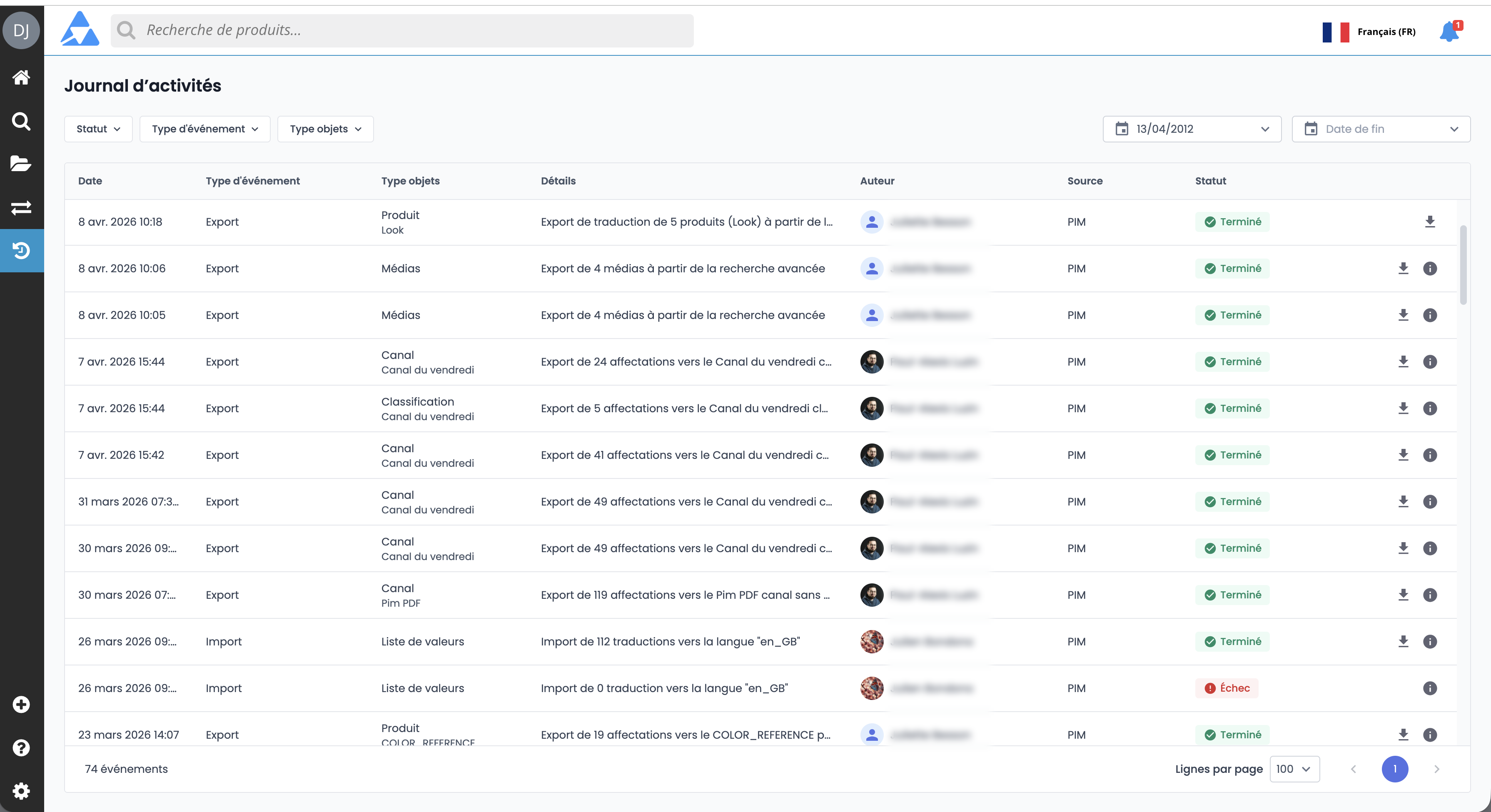
Good to knowThe list of processes is displayed as a table sorted in chronological order.
Activity types
All PIM processes appear in the activity report. They are grouped by category. Some activities have a major impact on your Quable PIM data and must be closely monitored. These priority activities are:
- Bulk edits
- Data flow Imports & Exports
- Indexing
- Activation / Deactivation of data languages (locales)
- Exports from advanced search (translation, asset, CSV)
- Thumbnail generation (Thumbnail profile, number of assets processed)
Good to know
- Tracking these critical activities allows you to quickly verify their completion and/or review and correct any issues encountered.
Activity report table
The page displays a table of your activity types.

The displayed information depends on the type of activity performed and its status. The table columns are described in the following sections.
Date
Date and time when the process was launched. The date and time are displayed in the time zone specified in your account profile.
Event type
Category of the process:
- Bulk edit
- Exports
- Imports
- Configuration
- Edit
- Deletion
- Move
- Image transformation
Object type
Type of entity involved in the process:
- Product records
- Variants
- Assets
- Links
- Classification
- Value list
- Channel
- Data language (locale)
Details
Textual description of the operation, for example:
- Manual indexing launched
- Modification of 2 products
- Editing of 3 products
- Full reindexing
etc
Good to know
- For imports or exports using a profile, the profile name is displayed.
- For related activities, the product type involved in the process is displayed.
Author
Name and avatar of the user who launched the process.
Access rights management
- All users can view the activities of all other standard users, regardless of their permissions.
Source
Origin of the trigger: PIM, Scheduler, or Portal.
Status
Current state of the process. This column displays one of the following icons:
| Status | Description | Icon |
|---|---|---|
| In progress | The process is currently running. |  |
| Pending | The process is waiting to start. |  |
| Completed | The process completed successfully without issues. |  |
| Completed (Errors) | The process completed, but errors occurred. |  |
| Failed | The process did not complete. |  |
Good to know
- Thanks to the color coding, it is easy to identify which processes require your attention.
- A Completed with errors process indicates that part of the dataset was processed successfully but that some rows contain errors. Open the details or download the report file to identify anomalies.
Contextual action buttons
Download
For import and export activities, you can click the Download link at the end of the row in the last column to download the file used during the process.

Imports - The imported file is downloaded in its original format.
Exports - The exported file is downloaded in a compressed format.
More information
Click the More information button at the end of the row in the last column, available for Bulk edit and Import / Export activities.

You will access a summary report of the activity.
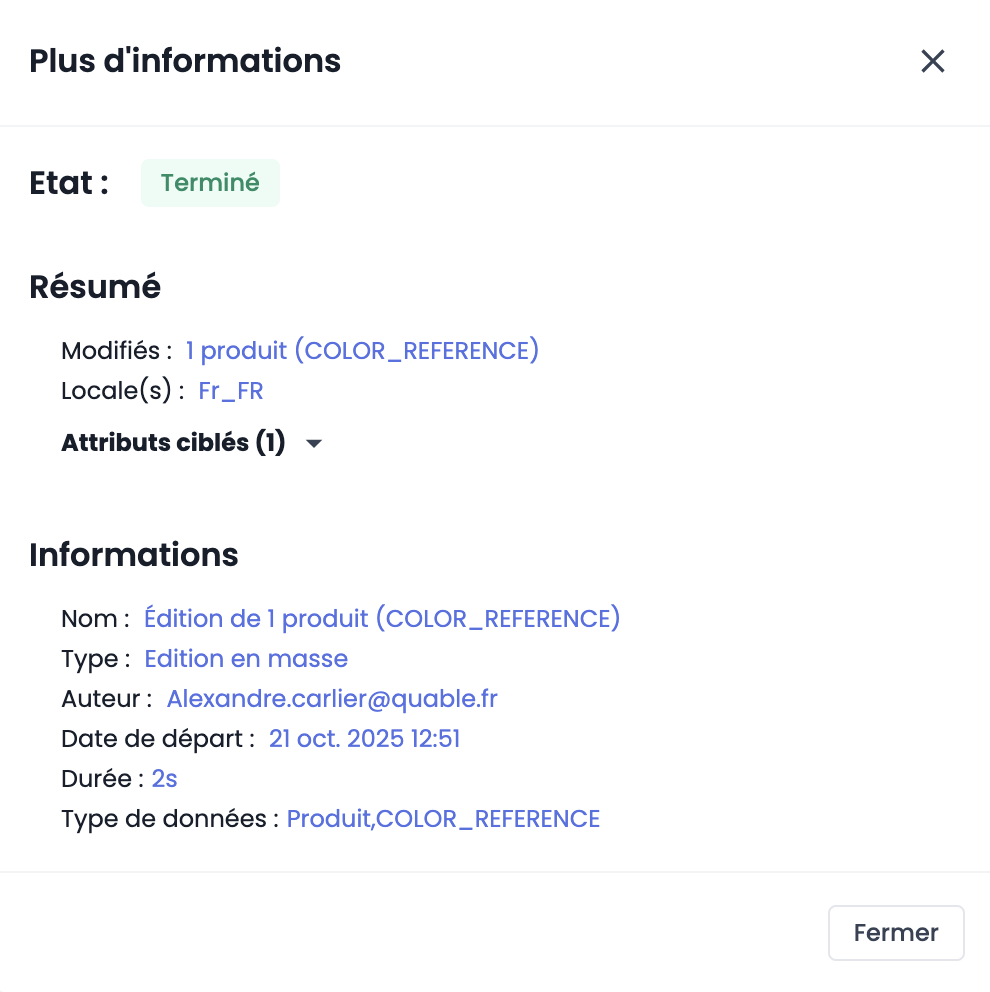
The report, depending on the process type, contains the following information:
| Type | Displayed information |
|---|---|
| Import | Profile used, file name, number of imported lines, number of errors, report recipient |
| Export | Profile used, file extension, destination (e.g.: FTP), email recipient |
| Export from advanced search | Number of exported records, document type |
| Translation Import/Export | Target language, number of translations, possible error codes |
| Bulk edit | Number of records involved, modified attributes, validation results |
| AI edit | Number of records processed, attributes enriched by AI |
| Thumbnail generation | Thumbnail profile, number of assets processed |
Good to knowThe summary report includes a Report file link allowing you to download an analysis report for successful import files.
Activity filtering
Filters are available above the activity table to limit and sort displayed activities.
- Filter activities by Status, Event type, Object type:

- Filter by Start and End dates:

The applied filters are saved between sessions: you will find the same criteria at your next login.
Updated 6 months ago